AFTER BONDI 2

AFTER BONDI 2

A note before I begin:

This post has been prompted by the responses to the previous post, so I would suggest that post be read first. Also, I meant to add a link to the Australian Book Review in which 5 Jewish Australians respond to the Bondi massacre. It is an excellent overview from 5 progressive writers – politically, religiously and culturally.

Here the link:

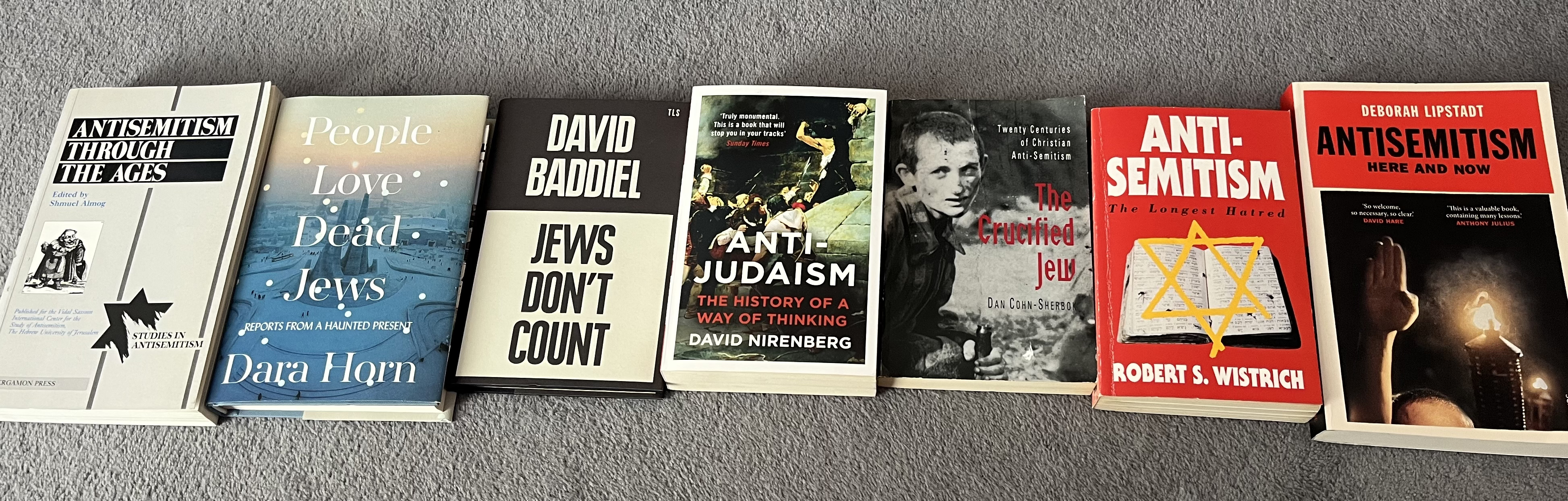
From my library.

I have been shocked at the level of antisemitism, how it has become normalised among certain groups. When people shout ‘Gas the Jews’, do they know what they are saying? Do they know about the historical reference? Do they want to kill Jews? Or do they want others to do the killing for them?

It is antisemitism that prompted the previous post: specifically, how people have used the actions of the Israeli government and military in Gaza to vent their hatred of Jews. People have also used the actions of the Israeli government and military to call for the elimination of Israel as a country. They argue that Israel should never have been brought into existence. This is what anti-Zionism means: that Israel has no right to exist. In contrast, a Zionist, as Lisa Hill points out, simply means someone who recognises and accepts Israel as a legitimate state, a country. 

As I wrote in my earlier piece, if not for the widespread hatred of Jews in the 19th century, the Zionist movement might never have been founded. And if not for the virulent antisemitism in Nazi Germany, 6 million European Jews would not have been murdered (while the allies did next-to-nothing to stop the slaughter). And if not for the murder of 6 million Jews (a number approximately the same as the combined populations of greater Melbourne and greater Geelong) there may not have been a guilty rush to give Jews a sanctuary/country of their own.

I define my own Jewishness in terms of family, history, culture and as a Jewish Australian. (Years ago, I wrote a long essay, ‘Only Connect: Musings of an Australian Jew’. I’ll post it under published essays in the next day or so.) While I do not feel a connection to Israel in the same way as other Jews do, I support the country of Israel, its right to exist, I support its legitimacy. But that does not stop me from being critical of the actions of the current government. I would like to think that this same view is held by Christians, Hindus, Muslims, Buddhists, and people of no religion at all.

And I support the right of Palestinians to have their own state. Both peoples have historical claims to the land, and, indeed, there have been periods in the past when Jews and Muslims have lived in peace alongside each other (as indeed many of the 1200 Jews killed by Hamas on October 7th had lived closely and peacefully with their Palestinian neighbours). Both groups have not been served well by their current leaders.

I abhor this recent trend in identity politics that would prevent non-Jews talking about Jewish issues, or non-Muslims speaking of Muslim issues. I hate the one-dimensionality of identity politics. So, of course I welcome the responses of Lisa and Tim. Indeed, after the Hamas killings on October 7th 2023, and following the Bondi Murders, I drew huge consolation from the many non-Jewish friends and acquaintances who reached out to me. They understood, they were speaking out, and I thank them for it.

I finished the earlier post with a comment about AWW’s disinviting of Dr Randa Abdel-Fattah to this year’s festival. I disagree with most of what Abdel-Fattah believes. She is aggressively anti-Zionist and has uttered offensive statements that can be easily interpreted as antisemitic. But I do not support her being banned.

Her banning is not, in my opinion, a free speech issue. Removing her from a public cutural forum like AWW will not silence her. Indeed, in these times there are so many on-line outlets where she, and others like her can say whatever they like without being called to account. A cultural forum is exactly where she should be allowed to speak, in real time, and subject to dialogue with people who can challenge her views. There’s not much in the way of dialogue nor opportunity for opposing views in the on-line silos. Bring her resentments and accusations out in the open, in the real world, where her views can be subject to scrutiny and challenged.

You are so right, Lisa, about the dirth of public support from literary and cultural institutions for Jewish creatives since October 7th. It’s been disheartening to say the least. I think the withdrawal of so many writers from the AWW, though, is not so much in support of Abdel-Fattah but rather resulting from what these writers believe a public cultural forum should provide. (As an aside, my good friend Dennis Altman and I, both of us with new books published since the last AWW, were rather miffed we didn’t crack an invitation to this year’s festival. How relieved we now are to be so neglected.) 

Tim – I really appreciate your drawing on the moral underpinnings of free speech and its dangers (coincidentally I’m reading about Elizabeth Anscombe at the moment), and I agree that speech that incites violence should be stopped. But at the same time there’s the distinction to be made between opinion/beliefs expressed in hate speech and propaganda/lies. There’s an element of coercion in propaganda, and it’s sinister as well: you’re being screwed and you don’t know you are. This is harmful. Hate speech can be hurtful, but at least it’s clear and unambiguous: you know what you must oppose. And at a public cultural forum, the speaker, one would hope, would be required to defend her position. (I should add, at this point, that I don’t know what sessions were planned for Abdel-Fattah, and with the AWW website now cleared, I cannot check.)

I held these same views when the English-speaking world’s most infamous antisemite and Holocaust denier, David Irving, was banned from entering Australia. Let him speak, I said. Let him be forced to defend what I consider an indefensible position.

AFTER THE BONDI MASSACRE

It is the oldest, most enduring form of racism, and the oldest, continuous expression of hatred. I refer to antisemitism, though I am reluctant to use the term, it is too polite, too cool, a euphemism of sorts for the far blunter (and some would consider unsayable) ‘Jew hatred’ or ‘hatred of Jews’. The term, antisemitic (antisemitisch), was coined by a German journalist, Wilhelm Marr in the 1870s. But hatred of Jews can be traced back to well before the Christian era.

While hatred of Jews and Zionism are often erroneously conflated in the contemporary period, historically they are connected. Zionism as a movement emerged not long after Marr’s neologism. Theodor Herzl (1860-1904), an Austrian lawyer and journalist, and the man considered the father of Zionism believed, along with many other secular European Jews of his time, that assimilation of Jews was desirable. However, given how widespread anti-Jewish sentiment was, assimilation was neither realistic nor viable, thus the need for a Jewish state. The obvious location was the region where Jews had historical roots and a significant presence, namely, Palestine.[1]

While Zionism was led by a German-speaking intellectual, the movement drew most of its supporters from pre-revolutionary Russia (which included present-day Poland and Ukraine) where pogroms, i.e. massacres of Jews, were common. Indeed, without the prevalence of Jew hatred one could hypothesise there might have been no Zionist movement. 

Since October 7th, 2023, there have been mass rallies in Australian cities. The sloganeering around Zionism has veered from the nonsensical ( ‘Zionism is Genocide’) to the ignorant (‘Globalize the Intifada’) to the murderous (‘Oct 7, do it again’.) And there’s been a swathe of specifically anti-Zionist slogans aimed at the very existence of the country of Israel (i.e. its right to exist) as against the actions of its government, the most common being ‘from the river to the sea’.[2]

Antisemitism, hatred of Jews, never goes away. It is not, as a young friend suggested to me ‘a light sleeper’: antisemitism never sleeps. As late as the 1970s in America some apartment buildings were ‘restricted’, a euphemism for ‘no Jews’. And here in Australia, the Melbourne Club was notorious in its prohibition against Jews as members; neither was it alone, a number of sporting clubs and golf courses had similar unwritten policies that banned Jews.[3]

When I was 8 years old a girl at my school called me ‘a dirty Jew’ (clearly an insult inherited from her parents), and in the 1970s when a close friend of mine was marrying a man with a Russian surname, her parents’ first response, was to ask, and ask with horror, whether he was Jewish (though they didn’t use the word ‘Jewish’, instead choosing to use an antisemitic term). Antisemitism, hatred of Jews, rumbles along with slurs and slogans until circumstances provide it with a platform to muscle up. And it rarely misses an opportunity to do so: from the death of Jesus to the black death; from Dreyfus to communism; from the Treaty of Versailles to whatever hardships Germany suffered after the Great War these circumstances are among the many that have been used to embolden the Jew haters.

We Jews are a diverse group. From the point of view of religion, there are ultra-orthodox Jews like the members of Adass Israel synagogue in Melbourne that was burned down a year ago in an antisemitic attack; there are orthodox Jews who keep kosher and wear a kippah and who are regular targets for Jew hatred; there are relatively secular Jews who attend synagogue maybe a couple of times a year whose children have barmitzvahs and batmitzvahs, but that’s about it; there are Jews who are right wing and conservative, and there are others, like me and the family I was born into who are left-wing and progressive.[4] There are Jews whose sense of being Jewish is connected to Israel, and there are many, like me, a Jewish Australian who is fifth generation Australian through 3 of her grandparents, whose sense of being Jewish is not linked to Israel.

Hatred of Jews has gone unchecked these past 2 years since the massacre of October 7th. I was shocked and appalled at the Hamas attack, but I have also been horrified by the Israeli government’s response. It’s one thing to hunt down terrorists, but not when it means the death of tens of thousands of Palestinians and the destruction of Gaza. So, I support the right of people to protest the Israeli Government’s actions. But the protests have become a grab-bag of grievances and a hotbed for antisemitism. ‘Kill the Jews’ people shouted on the steps of the Opera House on October 8th, 2023; this was BEFORE Israel had made any response. ‘Kill the Jews’, ‘Gas the Jews’ the protesters chant, many of whom could not locate Gaza or Israel on a map. So much hatred of Jews taking advantage of these protests. Antisemitism never sleeps, it’s an opportunist, it lingers in the shadows, waiting for an opportunity to act, and there has been generous opportunity these past couple of years. We Australians commonly criticise the actions of our political leaders, we criticise Trump, we had much to say about Brexit. To criticise the Israeli government is all very well, but not as a means to vent hatred of Jews.

What happened on December 14th at Bondi was inevitable. Any Australian Jew knows this. The unchecked rise in antisemitism since October 7th eventually saw 15 people murdered and dozens more injured. 

While antisemitism is the longest hatred, Islamophobia has burgeoned in the 21st century, using 9/11, and terrorist groups like Al-Qaeda and ISIS as fuel. Islam is the second largest religion world-wide behind Christianity, with Muslims commanding approximately 25% share of the world’s population against Christianity’s 31%.[5] Jews make up a meagre 0.2% which render a good many of the antisemitic conspiracy theories ridiculous.

Muslims who have made their home outside largely Muslim countries have suffered greatly, and continue to suffer, because of the actions of a few. Jews and Muslims have more in common, so it seems to me, than what divides us. We are both semitic people, we are both Abrahamic religions, and in these troubled times we both know what it is to be hated. Silencing people like the disinviting of Dr Randa Abdel-Fattah from the 2026 Adelaide Writers’ Week is not simply unhelpful, it actually feeds the hatreds. We need dialogue, and forums for dialogue, forums that include literary festivals as well as grassroots gatherings at local coffee shops. There are many instances of dialogue between our two groups – I know, for example, that my progressive synagogue has been involved – but we need more. We cannot leave it to Netanyahu and Iran’s Ayatollah or Trump to define us.


[1] In the early twentieth century, prior to the Balfour declaration, the British offered the early Zionists a swag of land in Uganda, but Herzl and his fellow Zionists held out for Palestine. One sees an echo of this in the Nazis’ early consideration of exile for Jews (as against mass murder) and the deportation in 1939 of several thousand German Jews to a barren area of Poland, at Nisko. There was also the joint Polish and French initiative of the late 1930s to exile Jews to Madagascar. Briefly, Australia’s Kimberley was considered as a place to which European Jews could be corralled.

[2] When Gaddafi was slaughtering his people did the world call for the elimination of Iraq (established as a country in 1921)? When the Taliban kill their people, as they are doing now, do we call for the elimination of the country of Afghanistan (established inn 1919)?  And when Robert Mugabe, the first president of independent Zimbabwe (1980) turned against his people, was there a call for the re-establishment of Rhodesia? 

[3] Euphemisms were generally used. Clubs and residential buildings were ‘restricted’, although the discrimination could be blatant like Lakeside Farm, a holiday venue for ‘Christian clientele’.

[4] My father (b.1919) always voted Labor and annually donated money to Israel. He said we Jews had more to fear from the right than the left, and if the worst were to happen again, the only country that would take us in was Israel. Times have changed, and I am so pleased he is not around to witness it.

[5] Pew Research Centre Forum on Religious & Public Life. Global Religious Landscape. December 2012.

ESSENTIALLY HUMAN (2)

Imagination and AI 

My previous post on memory, imagination and creativity, bought some great replies both on-line and off (track back – they are worth looking at). Might these essentially human functions be lost to we humans and taken up by AI? It was this question that prompted a follow-up article.

There was a time in the latter part of the last century, when ‘false memory syndrome’ featured regularly in the press. This condition, now largely discredited, caused me to widen my view of memory. How it was possible to make up memories of events that did not happen? Could one imagine a trauma? And might there be a connection between memory and imagination? And if there were, might it explain the common occurrence of two siblings having vastly different memories of the same family event. Was one correct /true/solid and the other false, or were both, infused by personal idiosyncrasies, partly imagined? Might my own memory of pivotal events in the past swing with my present desires and circumstances and be altered by them? Might it be loyal primarily to them? 

These sorts of musings came to the fore while writing my fourth novel, The Prosperous Thief (2002), in which memory is central. While most of the narrative takes place in the present day, the long shadow of the Holocaust hovers over the lives of the characters. As soon as I’d finished the first draft, I visited Germany and Poland for the sort of idiosyncratic and instrumental research novelists do. 

One November day, I spent an afternoon walking the paths and woodlands of Auschwitz 2, Auschwitz-Birkenau; this is the site where most of the killing at Auschwitz occurred. Here is the familiar rail track with the long platform where it was decided who would die immediately and who would be allowed to live a little longer (the ‘selections’), here is the pointed-roof gatehouse, and here, inside the complex, are the long huts where people lived and suffered and died. It’s a huge area, and apart from two cyclists taking a short-cut through the former death-camp, and three Polish schoolboys pilfering some Yahrzeit candles,[1]this place of mass murder was deserted. 

I wandered the pretty woodlands still rosy with late autumn colour where over a half century earlier Jews were herded together, made to wait their turn for the gas chambers. I stood in the ruins of crematoria 2, 3, 4 and 5 where hundreds of thousands of men, women and children had been reduced to ash. I wandered the seemingly endless columns and rows of wooden huts where Jews were crammed onto wooden bunks: the sick, the dying, the starving, and the steadfastly surviving all tossed in together. 

I walked past several of these huts down to the memorial slotted between the ruins of Crematoria 2 and 3. This is the International Monument to the Victims of Auschwitz. Built in 1967 in Soviet brutalist style, it consists of huge cement blocks in a geometric pile. In front of the blocks and set into the horizontal brickwork are plaques carrying the terrible statistics. This unimaginative monument is big and strikingly unbeautiful and, to my mind, communicated nothing about this terrible place. It was also totally unnecessary: this place, this Birkenau, was memorial enough. 

That visit to Auschwitz-Birkenau occurred twenty-five years ago, but I can still see the autumn colours and the school boys, I can hear the crunch of my shoes on paths made of gravel mixed with shards of human bone, I can smell the autumn mulch, I can recall my sorrow and anger and bafflement as I wandered that death-filled landscape. But of course I don’t ‘see’, I don’t ‘hear’ and I don’t ‘smell’, I imagine these impressions. And, as well, I add to them. I find myself musing on human brutality and prejudice, and what turns ordinary men into monsters; I think of the crimes that are committed in the name of patriotism and nationalism; I think of Trump and his MAGA movement; I think of the destruction of Gaza and the homeless Palestinian people. When I now remember my visit to Auschwitz, rather than a set of immutable images, I experience a far more impressionistic, complex event, one that acknowledges the numerous books I’ve read about Nazi Germany and the Holocaust, the films I’ve seen, the conversations I’ve had, the visits I’ve made to other parts of central Europe, values I hold, my knowledge of other horrors. My original visit to Auschwitz has become far richer in recollection, in that my entire cognitive landscape – experience, study, conversations, other memories, and fresh reasoning – has been recruited. 

This is how the imagination works. It shapes a memory that is fluid and intense and illuminating. It is also unpredictable: you cannot determine beforehand what knowledge and experience will be pulled into play during recollection, nor the ideas that will emerge from the mix. And it is unreliable, too. As a photo is not the whole story, that there is, as Barthes wrote, a ‘blind field beyond the frame’; so too with memory. All memory involves partial forgetting (outside the frame), and within the frame are new considerations, as my memories of Auschwitz show. Memory is rarely, if ever, static, nor is it neutral. We select what is to be remembered, and depending on the prevailing circumstances, what is selected this year will be different from what will be selected next year or in ten years. Far from being solid and immutable, this memory we trust is both delicate and infinitely corruptible, it is also free-ranging and expansive, linking with a swill of experience, desire, emotion, understanding, doubts, values and attitudes. 

Monuments provide a useful example to both the protean nature of memory and that it is never neutral. Memory, exactly what is remembered of a past event/desire/person is always in service to current values/desires/propaganda/politics. When monuments are built to mark pivotal events in a nation’s past, or to memorialise individuals killed in wars or terrorist attacks or murdered through genocide, there is an implicit assumption of an enduring, unchanging memory and commemoration. But the recent avalanche of falling statues of statesmen from the past who were involved in the slave trade or the murder of indigenous peoples is testimony to how changing values and culture affect how and what is remembered from history.

It was around the time I went to Auschwitz that I first put into words what should have been obvious to me and all those writers, visual artists, musicians, theoretical physicists, and mathematicians engaged in creative work (i.e. new work and ideas that have never existed before), that memory, fertile and changing memory, creative and illuminating memory, is an imaginative process, one dependent on the imagination and in turn constructing it.[2]

Which brings me to AI.[3] AI is an expert problem solver. In addition, having been ‘fed’ the contents of the web, AI can answer almost any question put to it – though not without mistakes. (There’s the oft-told story about an AI asked how to combat climate change, replied: ‘eradicate humans’ – not so much a mistake, because this would certainly work for climate change, but ignoring a number of other fairly essential issues.) Solving problems and answering questions is a matter of accessing already-existing data, it is not creative, nor does it necessarily demonstrate understanding. Understanding is different from thinking. Thinking is not the same as reasoning. And reasoning is not the same as creating.

What would an AI make of ‘the foul rag-and-bone shop of the heart’? Metaphor courses from the imagination. An effective metaphor is tangential to reality; it extends the meaning of that reality. Metaphor illuminates, it goes beyond the immediately obvious, beyond routine understanding.

Below are few more examples of metaphor – perhaps too many, but I do delight in metaphor

– Bernice Rubens: SPRING SONATA: ‘she tried to insinuate herself into the quicksands of her mother’s skin’

– Steiner in REAL PRESENCES: ‘memorising forms the ballast of the self.’

– John Banville’s THE UNTOUCHABLE: p.83. ‘The couple who ran the place were out of a seaside postcard, she a big blancmange with a wig of brass curls, he a lean little whippet of a fellow with a Hitler tash and a tic in one eye.’

– Toibin’s THE MASTER p.20 ‘the great flat foot of the public.’

– Auschwitz: ‘the eternal failure of all mankind’

– Virginia Woolf: ‘ideas are the only efficient air-raid shelter.’ (Essay: Thoughts on peace in an air Raid)

– Dorothy Porter: ‘In love I have no style. My heart is decked out in bright pink tracksuit pants.’  (THE MONKEY’S MASK)

‘The ripe teenage mulch of his bedroom.’ Ian McEwan. SATURDAY. p. 30

About Baxter: ‘that unpickable knot of affliction.’ p.272 ibid

‘You are like a tin of mixed biscuits.’ Iris to Carrington in Holroyd’s Strachey p. 352

Amichai OPEN CLOSED OPEN: ‘Enchanted places are the opiates of my life’  (69)

Zygmunt Bauman. LIQUID LOVE: p. 8 ‘Love is a mortgage loan drawn on an uncertain, and inscrutable future.’

Leibniz took music to be ‘God’s algebra’.  (Steiner ERRATA, p.75)

Edith Wharton. THE TOUCHSTONE. (P.110) ‘Vanity contents itself with the coarsest diet; there is no palate so fastidious as that of self-distrust.’

Mohsin Hamid. THE RELUCTANT FUNDAMENTALIST. (p.71) ‘Nostalgia was their crack cocaine… and my childhood was littered with the consequences of their addiction: unserviceable debts, squabbles over inheritances, the odd alcoholic or suicide.’

Sebastian Barry THE SECRET SCRIPTURE

p. 70 ‘We have neglected the tiny sentences of our life.’

p. 72 ‘There was a cold cheap cankered-looking moon…’

AI can regurgitate the OED, it can rearrange the OED, but can it go outside definition to metaphor? And what about art, art like Rothko’s, could an AI have produced that? Rothko was original. There was nothing that came before him that could be seen as feeders to Rothko’s extraordinary paintings. The same could be said for Cezanne and, more recently, those wildly evocative furry sculptures of Kathy Temin. Original art appears to come out of nowhere – where ‘nowhere’ is a unique human imagination. Could AI produce never-before-seen art, never-before-imagined art? And then there’s music. The great composers we revere today, wrote music that surprised and often shocked at the time. It was new, and it seemed that nothing had prepared their contemporaries for this music. I’ve heard music produced by AI. It’s nice enough but it does not have the shock value of a Gershwin who combined classical with jazz, or Schoenberg’s 12-tone music, or the uncanny transcendence of Bach’s music for solo piano and the cello suites.

The hearty spruikers of AI often refer to science when promoting AI’s skills, and certainly when it comes to medical science, AI has proved very useful, as it has with coding. But what about theoretical science? Could AI have hypothesized a nuclear chain reaction as did Leo Szilard as he crossed Southampton Row in London in 1938? And much of Einstein’s work had to wait decades before his theoretical, which is to say imaginative work, could be grounded in reality. Or Lisa Meitner’s extraordinary imaginative leap that lead to nuclear fission?

In the arts, in literature, in music and in theoretical physics, the imagination has produced work that comes from way outside the boundaries of current knowledge, current understanding, current reasoning, and previous imagining. Can AI do that?

_________________________________________________________________________________

And while I’m here, you may be interested in the following EVENT

1. I will be in conversation with Susan Wyndham about her latest book, the biography of the enigmatic Elizabeth Harrower, The Woman in the Watchtower. Susan is the former literary editor of the Sydney Morning Herald; she has worked as a foreign correspondent, has written a range of non-fiction, she is an excellent interviewer herself – I know from personal experience – and is a regular at all the literary festivals. Her new book is fascinating. This should be a terrific event.

When: Thursday, November 27th
Where: The Hill of Content, Bourke Street, Melbourne
Time: 6-7pm
Bookings essential: If this link doesn’t work, the link is on the Hill of Content website.


[1] I was furious. It was an affront to all who’d been murdered here, and all who had come to remember them. These boys were stealing memorial candles. I yelled at them as I ran towards them. They dropped the candles and fled.

[2] In recent years, the correlation has been given a neuroscientific basis. Demis Hassabis, neuroscientist, all-round genius, and winner of the 2023 Nobel Prize of Chemistry, published a paper in 2007 in which he linked memory and the imagination. He revealed that similar brain activity occurred during tasks employing memory of the past and tasks requiring an imagining of the future, and both were grounded in the hippocampus. Since then, much further work has been done in the neurological connections of memory and the imagination.

[3] I’m a writer, not a scientist. I have followed developments in generative AI and the predictions for artificial general intelligence in publications like The New Yorker and the New York Review, and in books aimed at a general audience – not in scientific journals. Consequently, I might be way off the mark. However, having just listened to the latest episode of The Times and the Sunday Times podcast, The Story, about the AI actor Tilly Norwood, I’m not going to back down just yet.https://podcasts.apple.com/au/podcast/the-worlds-first-ai-actress-and-her-creator/id1501716010?i=1000737864964

ESSENTIALLY HUMAN. 

Memory, Imagination and creativity.

When I was eight years old, I had three ambitions. The first was to be a ballerina – more a matter of wishful thinking than creative passion, given I wanted to be tall and slim, I was keen to wear a tutu, and I longed to be borne aloft by men who resembled fairy-tale princes. That ambition soon disappeared, snuffed out by common sense and a maturing aesthetic. The second ambition was to be a novelist. For as long as I could remember, novels had provided a refuge from the crush and uncertainty of my child’s life – a very necessary refuge given that childhood and I were not an easy fit. Filled with anxiety that I was getting the child role wrong, and ever alert to any tools that might help me navigate those perilous years, I studied other children in order to learn the ropes. The price of such vigilance was inexhaustible exhaustion. I was watchful during the day, and the nights were spent analysing the previous day’s mistakes and planning protective strategies for the next. The most reliable respite I had from this anxiety was not sleep (with so much to do I was a poor sleeper) but novels. I would slip into other lives and other places and relieved of my deficient yet demanding self, I would feel stimulated, invigorated, engaged, even happy – although like Samuel Beckett, I discovered that happiness was not as lively as I would have thought. Fiction supported me through the seemingly endless years of childhood, and from a young age I was determined to become a novelist. 

That I had decided to be a writer of novels could be explained in terms of the pleasure principle, self-preservation and escape. But I couldn’t escape all the time so what I needed was a reliable means of holding life in place. This need shaped my third ambition, namely, to have a perfect memory, the sort of memory that could learn poems by heart, that could reel off a page of numbers briefly glimpsed, that never forgot a person, place, event or story. If I could remember everything that had ever happened to me in the past, I would better manage the troubles that plagued my present, and gain a grip on the uncertain future.

My concept of memory in those long-ago days was akin to memorising. And I did so love memorising – poems, psalms, one year the entire geography book (I disliked geography but memorising the book as I walked around a deserted tennis court had a pleasing, hypnotic effect). In one respect, memorising was similar to reading in that both activities, by capturing my entire attention, removed me from the trials of childhood and my burdensome self. But that was the only similarity. Reading invigorated me, it sparked my imagination; I would travel to times and places not my own, and mix with people not to be found anywhere in suburban Melbourne. In contrast, my childhood memorising filled the time with a vaguely narcotic calm – like doing Lego or jigsaws or painting by numbers.[1]

To be a novelist and to have perfect memory: two linked ambitions to help steer me through the bewildering world in which I found myself, and through primary and secondary school they sustained me well. It was during my first year at university that I realised my dual ambitions were incompatible. I read The Mind of a Mnemonist, written by the great Russian neurologist, A.R. Luria, a book detailing the extraordinary memory of a man called ‘S’. This was followed a couple of months later by Borges’s Labyrinths, most especially, the short story, ‘Funes the Memorious’. Funes, an ordinary man in most respects, remembered everything; he could neither select nor forget. Beset by details, filled with details, Funes’s imagination was stifled. He was a man incapable of ideas or insight.

 ‘S’ and Funes demonstrated extraordinary feats of memory, like remembering pages of numbers or lists of nonsense syllables or poems in foreign languages, or the foreign language itself. Funes, for example, learned Latin in a week by memorising the Latin of Pliny the Elder as written in Pliny’s Naturalis Historia. But in  both cases this sort of memorising blocked the free-ranging imagination so essential to the novelist; it was a memory confined to particulars – a type of memory that excludes reflection and reason, inspiration and illumination. 

Novelists require a versatile, athletic imagination, one that can leap and loiter in the uncertainties of an emerging narrative. The novelist’s imagination is an explorer and thrill seeker. Perfect memory of the sort to which my childhood self had aspired is in service to safety and certainty; it is memory without imagination, it is memory at odds with metaphor, it is a memory as discreet and as immoveable as a picket fence. 

The memory that fuels human life and endeavour is far more creative than this. If I remember an event, say the breakup of an affair, it is not identical to the actual break-up. My recollection is overlaid with other experiences, other understandings, conversations, desires. Memory relies upon the recruitment of an entire cognitive landscape – experience, study, conversations, other memories. Just as Magritte’s painting of a pipe, Ceci n’est pas une pipe, so too my memory of the break-up, or, indeed, any memory. Memories are created, and what they recall is re-created differently with each recollection. 

This notion of memory is fluid and often illuminating. It is also unpredictable: we cannot determine beforehand what knowledge and experience will be pulled into play during recollection, nor the ideas that will emerge from the mix. And it is unreliable, too. As a photo is not the whole story, that there is, as Barthes wrote, a ‘blind field beyond the frame’; so too with memory. All memory involves partial forgetting, but what is forgotten is not erased, indeed, it is a common occurrence that, triggered by an experience in the present, a formerly forgotten element rises to consciousness. In addition to being unpredictable and unreliable, memory is not neutral. We select what is to be remembered, and depending on current circumstances, what is selected this year will be different from what will be selected next year or in ten years time. Memory is in service to the present far more than the past event it purports to preserve. Far from being solid and immutable, this memory we trust is both delicate and infinitely corruptible, it is also free-ranging and expansive, linking with a swill of experience, desire, emotion, understanding, doubts, values and attitudes. This notion of memory, this fertile and changing memory, this creative and illuminating memory, is one dependent on the imagination and in turn constructing it.[2]

We draw on memory to make sense of ourselves as we trek through daily life. It is memory that fuels imaginings of the future, it is memory that helps plan for it. It is memory that feeds the hopes and desires that drive us to seek out this person and abruptly turn from another. It is memory that seeds great art, composes memorable music, writes heart-stopping poetry and life-changing novels. A life without imagined, creative memory has been described by great neuroscientists like Luria, and it is a life confined in an ever-present where nothing much changes and art is indistinguishable from dust. A life without imagined, creative memory would be, for most of us, unbearable.

And yet it seems we are heading straight into that darkness.

Memory, imagination and creativity require a few simple conditions: uninterrupted time, solitude, no external distractions and the ability to sustain attention and focus.

In the digital age, for many, perhaps most people, simple factual memory – recall – of a name, a book or a film, has been rendered vestigial by web searches. Stop, I say, when someone reaches for their phone because they can’t remember the name of a book, an actor, a film. Stop, I say, give your mind time, give it space, the name will come to you. Mostly the person does not stop, does not wait. What would be the point? they imply, with a nod at their phone. Indeed, we have adapted so quickly to having information at our fingertips that when we want to know something, we want to know it now, whether it be the closest bagel shop (with pictures to show if the bagels are authentic), or a video clip of the admirable Jonas Kauffman singing Andrea Chenier (there is); it doesn’t matter what the nature of the information, we expect to have it immediately. 

Skills, which once were ubiquitous, have been lost. It would be a rare millennial or post-millennial who could read a map, but neither would they regard this as a loss Why bother, when they have GPS? And simple mathematical calculations – multiplying, division, percentages – these calculations would be beyond many people. But again, why bother, when you always have a calculator in reach? 

The history of human progress is also the history of lost skills. Few people these days would know how to rub sticks together to produce fire. Few people would know how to build a fire in a grate; quite a few people would not know what a grate is. And who would know how to read a sundial these days? But the loss of fire-making skills or telling the time by the sun, or reading a map, or doing simple maths do not diminish our humanness: they do not fundamentally alter what it is to be human.

Creativity is in a different sphere, creativity is essentially human. In our switched-on, digital world, sustained attention on a single idea, problem or issue has been lost to the dings and clicks of social media, news feeds, email, texts. Turn off notifications and that little screen still flashes. Solitude has being shoved aside by the need for constant connection and approbation. Checking a phone every few minutes is akin to laboratory rats pressing a lever for food, knowing that eventually they will be rewarded. So, too, with social media.

The mobile phone is the metaphorical heart beat of the modern individual. We sleep with it, run with it, eat with it. It accompanies us to the bathroom, it’s in reach while we have sex. It is a common sight to see two people seated together in a café each occupied with their phone, the only communication occurring when one shares their screen with the other. With WIFI blanketing the earth, even in wilderness landscapes the digital heart beats strongly. There is no repose. There is no time to mull in your own thoughts, to reach into the troughs of forgetting, there is no time for the imagination to flourish. 

Multi-tasking has inflamed the situation. Attention spans have not shortened in the digital age, but the nature of attention has changed. Juggling several tasks simultaneously is counter-productive to the singular attention – the obsessiveness –that creative work requires. With solitude and privacy under assault, and sustained attention of the sort the imagination requires fast going the way of the typewriter and the tape cassette, the conditions for creative work are being steadily eroded. 

Creative skills are surprisingly frail. As a writer, I know that when I return to my desk after just a few weeks away, the words don’t come so easily, the ideas are sluggish or, worse, non-existent. It takes a few days for the creative skills to muscle up again. The imagination, if neglected, readily becomes dormant; if it is not nurtured, it can actually decay. Muscles that are unused become stiff and painful and thereby draw attention to themselves. Unfortunately, the imagination goes far more quietly.

Running alongside this assault on human creative processes is the vast and increasingly complex advances in Generative Artificial Intelligence and Artificial General Intelligence. Generative AI has been designed with the capacity to learn and develop new data from its own actions/work, while Artificial General Intelligence is human-level intelligence that can do everything the human mind can do – and more.

An example of Generative AI was portrayed in a 2016 Go tournament between Lee Sedol, the world champion at the time, and the computer programme AlphaGo. Demis Hassabis, the scientist who produced the early work linking the neurological substrates of imagination and memory, was the primary creator of AlphaGo.[3]  

There were good reasons to choose Go to test the limits of the AlphaGo computer. There had been many AI-versus-human chess tournaments, but Go is far more complex than chess and, for seasoned players, creativity and intuition play a role. Many players speak about the game in quasi-spiritual terms. This spiritual dimension combined with the role of intuition underscore Go as a distinctly human-grounded game. 

AlphaGo demonstrated a level of self-learning in the tournament with Lee Sedol that even surprised its creators. One particular move, move 37 in the second game, was described by one Go Master as ‘not a human move’ but ‘beautiful, so beautiful’. This move had not been a part of AlphaGo’s programmed memory, rather the machine had created it.

Sedol lost the tournament 4 to 1 and, not long after, he resigned from the professional circuit. Since then other programs to play Go have been developed that are even more capable than AlphaGo. 

Generative AI is already with us, and artificial general intelligence with its open-ended creative skills is fast developing. There are daily warnings of the dangers of AI, including some from the founders in the field.[4] There are worries expressed over AI-written student essays and AI-generated novels, but there are far more serious concerns over the possibility of AI surpassing human intelligence and subjugating we humans. 

Whatever the future brings, it has already begun, and running in parallel has been the erosion of the very skills needed to maintain control of our human future. In our eagerness to embrace all the digital world has to offer, we have neglected to take stock of what we have complacently relinquished. Human imaginative work runs the risk of dying out, and with artificial general intelligence, creativity will become the province of the machines that human imagination and ingenuity produced. In short, we are creating the conditions of our own demise. AI isn’t taking over human creative endeavour, we have already ceded the territory.


[1] This childhood memorising is very different from the memorising of my adult years when, consciously and fully alert, I have worked to absorb poems and quotable quotes into the fabric of mind. As George Steiner memorably wrote: ‘To learn by heart is to afford the text or music an in-dwelling clarity and life-force…What is committed to memory and susceptible of recall constitutes the ballast of the self.’ (Steiner. Real Presences. pp 9-10).

[2] In recent years, the correlation between memory and the imagination has been given a neuroscientific basis. Demis Hassabis, neuroscientist, all-round genius, and winner of the 2023 Nobel Prize of Chemistry, published a paper in 2007 in which he linked memory and the imagination. He revealed that similar brain activity occurred during tasks employing memory of the past and tasks requiring an imagining of the future, and both were grounded in the hippocampus. Since then, much further work has been done in the neurological connections of memory and the imagination.

[3] An excellent account of the tournament is the documentary, AlphaGo, directed by Greg Kohs, and available on YouTube. Also Benjamin Labatut in his brilliant, unorthodox novel MANIAC, devotes the last chapters to the game of Go, in particular, this tournament between Lee Sedol and AlphaGo. 

[4] In his book Homo Deus: A Brief History of Tomorrow, Yuval Noah Harari analyses recent advances in AI and what they may mean for the future of humankind. The book was published in 2016, developments (some would prefer the term ‘progress’) since then are cause for far greater concern.

Faustian Pacts

I don’t remember when first I learned of Faust and the Faustian pact, but it was long before I’d read Marlowe, Goethe and Mann or heard Liszt’s Faust symphony or Gounod’s opera. I knew about gambling at quite a young age because my father used to go to the races, and he regularly enjoyed a game of poker with ‘the boys’ played on a card table set up in the living-room. So it was not surprising that my early understanding of the Faustian Pact was as a type of gambling: balancing loss and reward within a framework of risk.

As a child, I used to wonder what I would be willing to risk to be thinner, smarter, taller, more self-assured, relaxed, calmer. What would I be prepared to give up in the future to be the person I want to be NOW. Of course, for a child, the future is a vague and watery concept and not overly desirable: to be grown up is to be like the older people in your life – not an attractive prospect at all.

I was in my twenties when I read the Fausts of Mann, Goethe and Marlowe – in that order. I read the Mann first (it was during my Mann phase). and being first and also about a musician, it lodged firmly in me, far more so than the other versions. Through the various stations of my life – and at my advanced age there have been quite a few – there have been several re-readings of Mann and Goethe, and each time I have posed the same question: what would I be willing to do and to forfeit, to be or to have X, Y or Z?

The question has changed weight with the years. What was a simple equation of desire when younger has gained considerable moral complexity with age. After all, there are other people to consider and a world in flux; personal gain must be justified and deserved. Literature’s various Fausts paid little mind to broader moral concerns, in fact the contrary occurred in that each case can be seen as involving an exclusively egocentric desire/choice/decision, and like a child, none of them gave much thought to the pay-up time in 24 years.

My consideration of a Faustian Pact has tended to remain in the personal sphere – I’d like to think it was because of literary taste and intellectual curiosity, but I expect life’s dissatisfactions and disappointments provided if not a driving force, more than the occasional shove – but with the dominance of Trump and the surge in right-wing nationalism the notion of the Faustian Pact is being played out in the public arena. 

How on earth do those Republican congress people live with themselves, with their craven toadying, their bending the knee and tugging the forelock to Trump? And the praise they heap on him, fuelling his vanity (one cannot help but wonder at a grown man having such need). And this is all done because they fear the consequences if they cross him, and the consequent spoiling of their ambitions. But what is the role of a congress person if all they can do is agree with the great leader? This is not representing their constituents: the job they were elected to do, they are not doing. Of course they would say they are protecting their job in the future, but does that justify 4 years of neglecting the people who voted for them? 

It’s big business for the devil in Washington DC these days. Indeed, there’s so much work the devil has needed to co-opt a team of AI (the boys at Big Tech have been unsurprisingly obliging).

As for Trump himself, narcissism has no need of a pact, Faustian or otherwise. The narcissist only needs to please himself. Everything is his due. No payment, no pay up time. Corruption? It’s irrelevant to the narcissist; he takes what he wants, what is his right. He may pay some mind to his family, but I suspect none of them cross him – except perhaps Melania. 

No deals with the devil in the Executive Residence, so it’s fortunate there’s so much business elsewhere. 

And I cannot help but wonder what Mann would make of all this, Mann, who lived through the Nazi period, who went into exile to escape Hitler’s regime, who spoke out against Hitler, whose own Faust draws on and reflects upon those terrible years.

RELICS FROM THE PAST

(Published in THE MONTHLY, September, 2025)

On an Autumn day in Melbourne not so long ago, while travelling home on the train, I was caught by a scent. It wafted over from a woman seated across the aisle. Her hair was short and blow-waved neat, her coat was buttoned, her handbag was upright against her hip; she was a woman in her middle years, occupied with her phone. I willed her not to disembark until I had found the memory of the smell. It was teasingly familiar, yet I knew it lodged in the distant past. I inhaled more deeply and felt a flush of happiness. A moment later, the happiness was swamped by a wave of anxiety and longing.

What was that smell? I rummaged through memory, but despite the powerful feelings it engendered, the original source remained out of reach. 

The woman slipped her phone into her bag, stood up and moved to the door; soon she would be gone. I wanted to grab her, hold her back till the scent revealed itself. The train slowed, the platform of the station appeared, then, just before the doors opened, it came to me: it was hairspray, the Elnett hairspray my mother used to helmet her hair back in the 1960s. (I would normally avoid turning a noun into a verb, but the hairspray did, in fact, make of her hair a helmet, and it did so actively enough to warrant a verb.)

I had solved the mystery of the smell, but I was curious about its emotional baggage.  

My mother died in 2012. Twenty years earlier, while in her mid-sixties, her cognitive skills began to dwindle. In the last eight years of her life, she recognised none of her family; in the last three years of her life, she could neither walk nor talk. Before the dementia, and probably because I was more like her than were my sister and brother, my relationship with my mother was not easy. I spent my childhood trying to win her approval, or perhaps, more simply, her attention. I would stand beside her as she sat at her dressing table, one of those old-fashioned ones with a central mirror and two side wing mirrors – three versions of my mother as she teased her thin hair and stiffened it with Elnett hairspray. The last element of her beauty regime was to apply perfume to her neck and behind her ears – it was Je Reviens by Worth in a small round blue bottle – then she would turn to me, silent and desperately hopeful, and dab some of the perfume behind my ears. The anxiety and longing disappeared in a moment of pure happiness.

Smells and memory, such a powerful, yet mysterious coupling. I can bring to mind something visual, I can imagine a voice or a piece of music from the past, but I cannot imagine a smell – nor, with a nod to Proust, taste. But perhaps such considerations are moot, given the capriciousness and capaciousness and plain bloody-mindedness of memory. After all, each time memory summons up a particular past it produces a different version. The life since the event changes the perspective on the past event, as do the reasons for wanting to recall it. Memory is always in service, first and foremost, to the present and not the event it seeks to restore. I may not be able to recall a smell or taste in the way I can a picture, a face or a piece of music, but the fact is, no memory is faithful to the past.

And yet, there was that raw longing, that look-at-me ache, conjoined with the Elnett hairspray. It was primitive, juvenile, it served no purpose, so I wanted to believe, to the adult I have become. It was of then, and it trespassed into my now.

I was nineteen or twenty when I first came across Sartre’s 1964 memoir of his childhood, Words  (Les Paroles). I was immediately drawn to it because of the cover of my Penguin edition. Instead of the usual image, the cover carries a quote from the book in a huge font: ‘I loathe my childhood and all that remains of it…’ 

I shared this sentiment – I still do, although with a little less vehemence than Sartre. But what most appealed was that a very famous person dared contradict the assumed innocence and care-free quality that defined childhood.

I wanted to pack childhood away as soon as it was finished, but childhood will not go so quietly; indeed, I’ve come to believe that childhood claims the better part of memory for itself. Miserable or happy, privileged or deprived, pivotal aspects of childhood are tenaciously entrenched. Yet, as my experience with the Elnett hairspray demonstrates, these memories can hibernate beyond conscious reach for years, even decades, only to bombard as you make your way through maturity.

There’s nothing new about this: a century ago, Freud revealed that the ignored past, the forgotten past, the past of which you are unconscious, can nonetheless exert a powerful effect on who you are and how you behave. And yet we live, most of the time, as if unaware of being tethered to the past, and when old events gate-crash the present they result in surprise and shock, they can readily throw you off balance. 

These thoughts led me back to Walter Benjamin’s essay on Proust. Benjamin writes of ‘purposive remembering’ with its strenuous efforts to recollect and, in the case of A la recherche du temps perdu, to imaginatively restore the past. ‘Purposive remembering’ suggests that a reconstruction of the past is possible. But it’s not, and why imagination is essential to memory – not simply to fill in the gaps, but also to provide the multi-dimensions of lived experience: the facts, the movements, the emotions, the smells and tastes

In the days following the Elnett hairspray event, I mulled over the liquid connections between imagination and memory. Joyce wrote that ‘Imagination is memory’; I would propose the reverse: that memory is imagination – not the entire infinite stretch of the imagination but rather memory is a process of the imagination.[1] The idea that memory is fused with the imagination, that all memories are distilled in the imagination, provides for the malleability of memory. The fact is that when I focus my mind on the child standing at her mother’s dressing table now, I understand the situation slightly differently than I did just a few weeks ago, feel it differently, and know it differently, too.

There was a postscript to the Elnett hairspray incident. Driven by nostalgia (definitely not curiosity) I went on-line and discovered that the perfume my mother used, Worth’s Je Reviens, was still being produced and was available from a shop in the Melbourne CBD. (As to why the perfume and not the hairspray: I use perfume every day, but have no need for hairspray). I caught the train to the city, I went to the shop. The perfume came in two sizes, each sealed in the familiar blue box. I bought the large bottle – far better value, according to the woman in the perfume shop, but that was not what convinced me: I assumed my mother, who used the perfume every day, would have used the large version (even though in my memory the round blue bottle was quite small). But I was wrong. When I removed the perfume from the box the bottle was the right shape and the familiar rich blue colour, but it was far too big. My mother used the small size – which, I expect, was the only size available back in those long-ago days. I was so disappointed, I was wanting exactly the same, I was wanting to revisit exactly that old scene. To experience it again. Fortunately, the scent had not changed. I put some on my wrists, I wanted to keep smelling it, smelling the better part of a difficult childhood. 

The headache began almost immediately, first the shadow that presages the pain, then the pain itself which, in most instances will morph into migraine. There are many perfumes that do this to me, but surely not Je Reviens

I persisted – I so wanted to wear this perfume – but so did the migraine. I gave the bottle to my sister. And the memory? It has changed again.


[1] in 2007, a team led by Demis Hassabis published a paper in which memory and the imagination were linked. They showed that similar brain activity occurred during tasks employing memory of the past and tasks requiring an imagining of the future, both being grounded in the hippocampus. Since then, much further work has been done on the neurological connections of memory and the imagination.

OF WONDERS WILD AND NEW

(From poem at the beginning of Lewis Carroll’s Alice’s Adventures in Wonderland.)

I must have been in need of a role model when first I heard of Eve and her transgressions in the garden of Eden, because from the beginning I disagreed with the interpretation promulgated both by my Methodist school and my Jewish background. Feed off the tree of knowledge and suffer for all eternity? It made no sense. Without curiosity and its rewards, childhood, with its trials and expections, would be unbearable. God’s Eve might have been bad and disobedient, but my Eve was rebellious and dismissive of parental authority. She’d had no say in the Adam’s rib business, but her response to the snake revealed her to be curious and confident and courageous. Thereafter, she flaunted her independence and showed Adam who ought to be boss. 

‘And when the woman saw that the tree was good for food, and that it was pleasant to the eyes, and a tree to be desired to make one wise, she took of the fruit thereof, and did eat, and gave also unto her husband with her; and he did eat. And the eyes of them both were opened…’ (Genesis 3:6-7. King James Authorized Version).

Later, when I read Milton’s Paradise Lost, my admiration for Eve only increased. Milton is no 17th century feminist. His Satan locates authority, intelligence and valour in man, and ‘coy submission’, beauty and grace in woman. But how is this demonstrated? Eve acts, while Adam only responds. Eve defies authority, and does so with determination. Milton proves my case, not his – nor God’s for that matter.

As for curiosity, it is the greatest of the human passions – not that I was aware of this as a child. I embraced curiosity because it worked for me. The family is a crowded place; I shared a bedroom with my sister and the living room was communal space, but curiosity was private. It was fed and satisfied by books and thoughts, and it opened up endless possibilities located far away from suburban Melbourne. And that was the wonder of it: one question led to other questions, and you’d find yourself in imagined terrain that was fabulously interesting and sparking with risk. And given you didn’t need to leave home, you didn’t even need to leave your chair or the nook at the end of the garden, you were entirely safe – an important consideration for a child so anxious that even sleeping was a threat. Crucially, curiosity removed me from the daily terrors of being a child, and at the same time, it made solitude a most desirable state. I was rarely bored during the interminable years of childhood, nor was I decades later during the seemingly endless covid lockdowns. With curiosity powering the imagination and stirring the currents of memory, no one need ever be bored.

                                    *          *          *          *

There’s an epidemic of loneliness and boredom in societies like ours, yet it seems we’ve never been busier. Frenzied digital connection from unlimited Wordles to compulsive checking of social media to fevered on-line shopping and mesmerising doom scrolling distract from the boredom and loneliness while, at the same time, being a symptom of these, and probably further feeding them.

So much activity with so little to show for it, accompanied by a pervasive dissatisfaction that seems unappeasable. As for the smart-phone: sometimes it feels like the phone controls you and not the other way around, a bit like the oppressive partner you know you should leave but you can’t bring yourself to do it. The solution is not constant, mind-numbing activity, but active, ceaseless curiosity. This is not a quick google search for the name of a film, a song, a place, a date, that’s not curiosity, that’s just a quick-fix for frustration over a forgotten fact. Curiosity is the determined search for new understandings, a hunger for new experiences, new people and places; it’s invigorating and productive, it starts at one point and shoots off vectors in all directions. With curiosity in full flight, boredom and loneliness don’t get a look-in.             

An active curiosity is like the ardent traveller: implicit to both is the notion of search, of a journey into the unknown. You spend a day wandering in x direction, the next day you change course. You gather knowledge and understanding from both the forward movement and the wrong turns, and when you arrive back at the starting point, you are filled with new understandings and, as T.S. Eliot famously wrote, you return to where you began and know it for the first time. 

Most significantly, given the prominence accorded to the self in the digital age; curiosity turns you away from yourself towards the world, towards new places and other eras, and into the lives of people very different from you. Curiosity could make humanitarians of us all. 

Surrounded as we are in constant noise and an avalanche of information, this greatest of the passions, this resource for living has been left to moulder away in a dark corner of mind. It is hard to think of another resource that costs nothing and is available to all human beings. You can activate it while cooking, or changing the bed-sheets, or watching your child play footy; you can slip into it while travelling to work, delivering noodles, ploughing a field, while walking the dog. The major requirements of curiosity are time and privacy and solitude. Turn off the music, resist your favourite podcasts, don’t call your sister/mother/son/best friend. Put your phone in a drawer or put it on silent and go mental wandering – curiosity by another name.

Which leads me to Trump, as most musings do these days. Even though we know his power is hinged to having our attention, his being plastered across the news and social media, filling podcasts in umpteen different languages makes it is so difficult to ignore him, to turn him off. And besides, for many of us, there is a macabre fascination with this man who has colonised the hearts and minds of millions, who has turned the Republican Congress into a forelock-tugging bunch of lackeys, a man who, either deliberately or simply shuttered within his massive ego, is upending the world order. This man, so loved by his MAGA followers, is seen as a dangerous narcissist by his detractors, a man who disregards anything that does not enhance himself and his power. This is a man so satisfied with himself, not only does not demonstrate curiosity, he has no need for it. 

I don’t believe I’ve ever known Trump to ask a question – and not surprising in a man convinced of his own perfection, his own greatness, his rightness. He does not seek advice from his advisors (given the lack of appropriate skills and experience of most of them, this could be seen as an unexpected benefit), he seeks confirmation only for what he already thinks/wants/believes/needs, which is to say, himself, Donald J. Trump and the web of his selfhood. 

There’s nothing special about Trump’s narcissism; like any narcissism it is incompatible with curiosity about people and events and places beyond his personal domain. Indeed, if Trump’s minions fail to stroke his ego, they find themselves unemployed, and, in many cases, unemployable. This man, entrusted with the lives and fate of not just Americans, but much of the rest of the world, lacks the fundamental passion of what makes us human; this saviour of the working American, this nasty narcissist does not give a damn about his adoring followers, nor all those drooling republican congressman, and he certainly does not give a damn about the conflicts in the wider world (unless, of course, he can insert himself as the fixer-saviour). This narcissist, inoculated as he is against curiosity, is, simply, not interested.

UNSPOKEN DESIRE, UNREQUITED LOVE

(published in The Weekend Australian, March 1st, 2025)

Desire is so…desirable. How bland and static life would be without it. And there’s so much to recommend it. It comes in a great many varieties – no chance of boredom – and it’s so portable: where I go, so, too, my desires. But the feature that most appeals to me is that desires can remain private. Most desires are created by the mind, and there they can stay – no need to subject them to reality to enjoy their pleasures and enlightenment. This is a very good thing, because when they are exposed, it can be a disturbing, even distressing experience.

There was a teacher I admired during my high school years, admired and adored; I shaped my behaviour to win her approval, I owned beliefs because I knew they were hers; this teacher inspired a clutch of desires and was, in turn, enhanced by them. A couple of years ago, while artist-in-residence at an organisation of which my former teacher was a member, she and I attended the same lunch function. Decades had passed, yet I felt all the tremors of youth when I caught sight of her. Emboldened by my position as artist-in-residence, I found the courage to greet this woman who had exerted such an influence in my adolescence. I approached her table and stood by her chair; she looked vaguely at me. I said my name: there was no recognition. I fumbled a few more facts and when there was still no recognition, I mentioned the name of my best friend at school, and immediately her face lit up: an exceptional girl, my former teacher said, one who would go far. My friend was remembered, but I had been forgotten; worse, it was if I had never existed. There were flyers throughout the building displaying my photo, my name, a brief biography, and still I was a total stranger to this woman who had meant so much to me during those impressionable years. All those private desires that had channelled me through high school, desires that attached to ambition, to ideas, to music, desires that had remained polished and private throughout my adolescence and beyond, and she did not know me.

I wish I’d not seen her. Desire, imagined desire, untainted by reality is never disappointed.

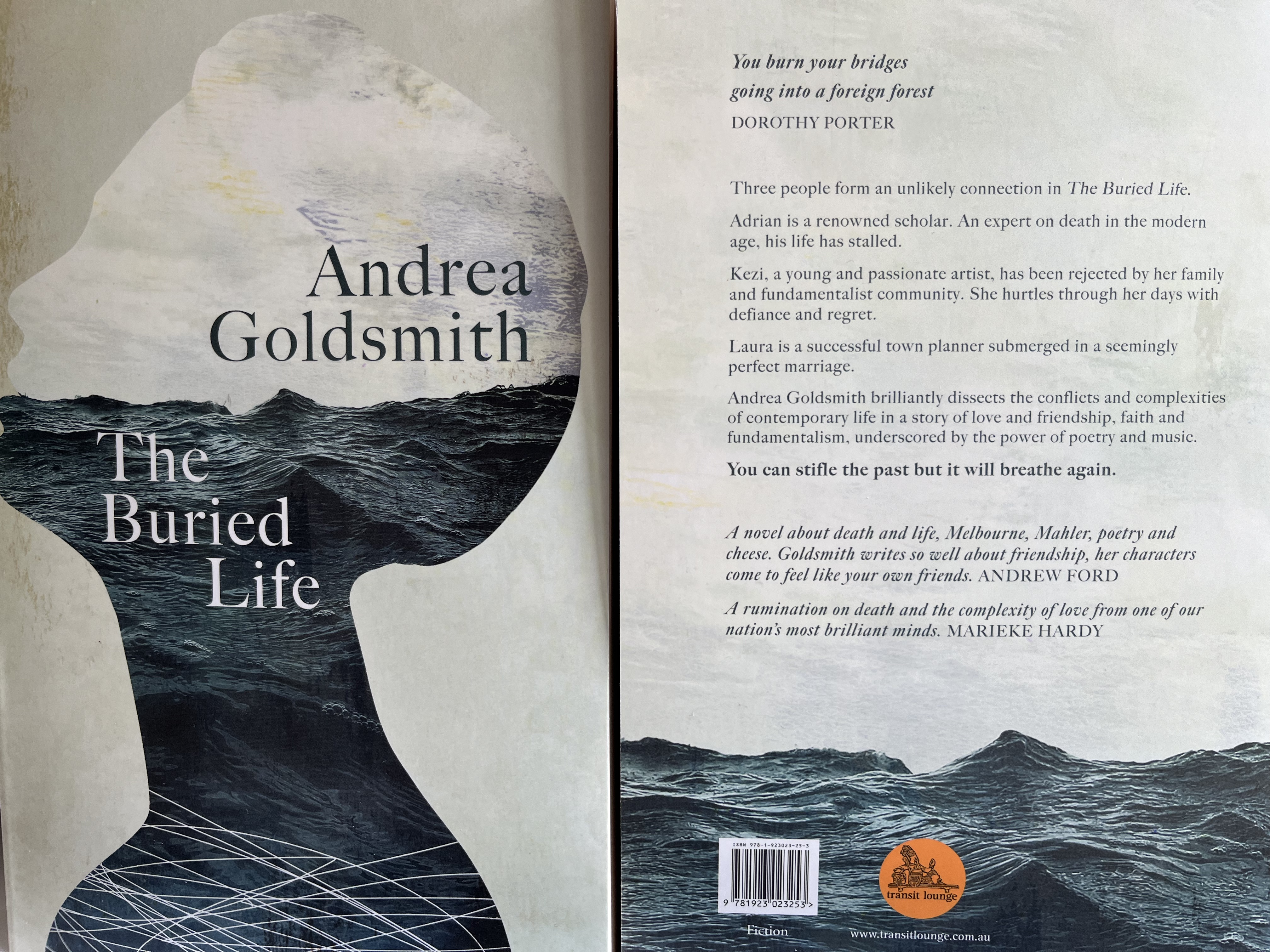
In my latest novel, The Buried Life, there is a romance between a forty-three-year-old man, Adrian, and a fifty-seven-year-old woman, Laura. Adrian is not at all bothered by the age difference, it is Laura who worries. She’s self-conscious about her ageing body, the newly-acquire flab on her abdomen and thighs, the beginnings of crepe in the underside of her arms, but it is mostly desire itself that is on her mind, and in this instance it is the intensity of her sexual desire for Adrian Her thirty-year-old self, even her forty-year-old self would have said that anyone approaching sixty would be beyond such feelings. Perhaps one never was, perhaps at that very moment there were nonagenarians rolling around in an erotic frenzy at their aged-care facility.

And perhaps there are, but I doubt it. Though I would like to think that rampant desires – artistic, sporting, intellectual, epicurean – are filling the minds of the aged-care residents. As the body ages, it becomes irritating, intrusive, burdensome, but, in the absence of cognitive decline, the imagination, that crucible of desire, goes from strength to strength. This is one of the great benefits of advancing age.

Imagined desire, there’s little to equal it and, aside from reality, nothing to stop it. Imagined desire is bold, curious, energetic. And imagined desire – private desire – can also be very productive.

I have enjoyed an unrequited love of more than thirty years duration, a passion that ripples with many kinds of desire. This man is a similar age to me, I’ll call him P (not his initial, but with that whispered plosive, /P/ is my favourite letter). P was beautiful, brainy and bookish when first I met him, and so he remains. We meet very occasionally, always with eager anticipation and always with outward decorum. But even though it has never been acknowledged, I am sure P harbours a secret passion for me, too.

And such a satisfying love mine has been. I’ve orchestrated long and complex conversations with him; no idea, no book, no topic is beyond us. P has fired up sexual desires both for me and for my characters. I can spend time with P when I look a mess, when I’m grumpy at the end of a tiring day, when I’ve gained weight. And P, himself, has no downside, no qualities to spoil his perfection. He may be less bookish and brainy than my desires require him to be, but it doesn’t matter. If he scatters his clothes across the floor, I don’t see it. If he has a sour odour in the mornings, I don’t smell it. If he complains about this relative or that colleague, I don’t hear it. Any faults, and I expect he has a few, are outside the realm of my P. 

I can imagine every embrace with P, every sexual act (including those I’ve never tried but wish I had), and I can make use of these, have made use of them in the books I have written. Indeed, for most of my nine novels any satisfying and sexy relationship has been fuelled by P. And it doesn’t stop at sexual desire. I have crafted conversations with him while taking solitary walks or while idling at my desk – rigorous, referenced, and ranging over a variety of topics. These conversations can occur almost daily if I am trying to get to the nub of a particularly knotty conundrum.

Reality would not simply spoil this, it would stop it altogether.

In the early drafts of The Buried Life, I made Laura’s desire for Adrian unrequited. But an unrequited love like mine, so satisfying in real life produced narrative tedium in the novel. And besides, at fifty-seven, and caught within a long marriage, Laura deserved some good sex and stimulating conversation. 

But for me, I would always choose my long, intense, unrequited and unacknowledged love with its bottomless well of desires. Wholly satisfying and forever untainted, it remains ageless and reliable.

THE BURIED LIFE

The Buried Life, my new novel, is about to be released (Transit Lounge, March). It will be launched by Mark Rubbo of Readings Books on March 11th, at the Abbotsford Convent Melbourne. In addition to the conversation with Mark, Frances Atkins, will play music from Mahler. (Mahler’s music figures in the novel.)

Bookings for the launch can be made through the Readings website, click onto events.

The Buried Life began with a desire to explore that great taboo, death. It has always surprised me that a human event which happens to us all inspires so much fear. As for dying as a process, it strikes me as oxymoronic. One LIVES right up until the time one dies. I have sat with 4 people in the hours before each of them died, and they lived, even unconscious they lived up until their breath stopped. Epicurus expressed it best: Where life is, death is not. And where death is, life is not. As for suffering a death, it is suffered by the living, by those who are left behind.

This is not to suggest there’s no mystery in death. An abundant cache of poetry and music, samples of which are included in The Buried Life, is testimony to death’s enduring mysteries.

I have a 9-page document of death books and poems. Here are a few of my favourites.
Dylan Thomas: Do Not Go Gentle.
Neruda: The Dead Woman (this was quoted in the film Truly Madly Deeply)
Larkin: Aubade
Ted Hughes: The Crow Poems and Birthday Letters
Tennyson: In Memoriam A.H.H. (Arthur Hallam)
Hölderin: The Death of Empedocles (on Etna) (Also Matthew Arnold’s version) 
Edward Hirsch: Gabriel
Douglas Dunne: Elegies

It’s not surprising that the first character of The Buried Life to emerge was Adrian Moore, 43 years old, a scholar of the social and cultural aspects of death. His life has been shaped by the early deaths of his parents – although he would strenuously deny this.

His closest friend is Keziah, Kezi, 28 years old and estranged from her family and the fundamentalist community in which she was raised. She would like to bury her past in the way Adrian has, but it refuses to let her go.

Both Adrian and Kezi meet Laura Benady, a town planner in her late fifties, long married to a man Laura believes to be perfect.

As the novel grew, faith and fundamentalism, varieties of love, coercive control and the power of art all surface as Adrian, Laura and Kezi move through their lives – and the life of the novel.

One of the truly magical features of writing fiction – and reading it too – is that the imagination, when allowed time and space, will take you to unexpected places. A novel that began with death evolved to grapple with some of the great complexities and conundrums of life.


THE END OF PARADISE. A forgotten short story.

In the months since I last posted here, I finished my ninth novel, THE BURIED LIFE (to be published March, 2025), I’ve been snow-shoeing in the Arctic, and I’ve been going through old files, jotting ideas for new essays, and working on some existing ones. So – there will be less neglect of this site in the future.
I’ve never considered myself a short story writer even though my first publications were short stories. The long form of the novel suits me better. So I was surprised to discover a forgotten story, THE END OF PARADISE. It was published in the Sunday Age, January 5th, 2003 – still a broadsheet then, in their summer series of fiction, and yes, there was fiction in the newspaper back then.
In the original there was no space between paragraphs and proper indenting – so apologies for the format here.

THE SUNDAY AGE. 5/1/03

Part of the Summer Reading Series

THE END OF PARADISE

Emma Klein’s was the sort of beauty that held your gaze and turned it soft. If Tony Drummond were to capitulate to a shallow moment he would admit her face had been the initial attraction. And while it was joined by others in the time they spent together, the face remained the primary lure. 

Of course it would be different now. In the 15 years since their affair, Emma had evolved from beautiful, unknown film student to beautiful, celebrated auteur. With brains and beauty she was, according to Tony’s colleague Jeannette Redi, the full quid. Which explained why Tony was now at his keyboard, pondering what to write to a woman he’d not seen for years, a woman who would not be much interested in him if she’d opted for suburban anonymity, much less an international film career.

The truth was that Tony had done her wrong, so wrong that if his own career prospects were any less precarious he would be leaving Emma Klein undisturbed in his past, neatly shaped by a memory devoted to his own well-being. Unfortunately, this same well-being was now under threat. Hurtling towards 50 and still not a senior lecturer, with no major publications and economic rationalisation ripping through the fibres of higher education, if Tony didn’t come up with a research project soon, it would be a redundancy package and time to kill.

Jeannette Redi had been right.

“You know Emma Klein?” Jeannette had been incredulous. About to leave the Faculty Club where she and Tony had eaten lunch, she settled back at the table and ordered another coffee.

“It was an age ago,” he said, in an attempt to curb her interest. “Long before Sup with the Devil. Long before she was famous.

“But don’t you see, Tony? She’s the answer to your problems. She’s your promotion. At the very least, she’ll save your job.”

Jeannette might have been less enthusiastic if she’d known the whole story. Tony had been a tutor, Emma his brightest student; he had done what tutors did prior to anti-discrimination and sexual harassment laws, she had fallen in love; he had pressed his body, she her devotion; he had provided an A-grade performance in sincerity, she had offered the authentic thing. After she handed in her final assignment he had tried to let her down gently, then less gently, then plain bluntly. He hadn’t asked for her love, he said, and he certainly had no use for it now.

He had behaved badly, no doubt about it, but then he’d always been susceptible to appearances and Emma Klein had appearances down pat. Her black hair flicked around her face, falling thick and touchable over her shoulders. The skin was richly olive, suggesting not-too-distant Sephardic ancestors. Then there were the eyes around which the whole face congregated.

Tony regarded himself as something of an expert in eyes. Not long before he met Emma, he had drafted a paper on the problem of eyes in literature. Eyes, he wrote, had been forced to reveal, hide, deceive, promise, condemn, betray, deny, love, hate, envy, even murder. This was plain absurd: eyes simply did not have such a large and readily interpretable repertoire. But after meeting Emma he had been forced to revise his opinion, although it was clear that most writers had been profligate in their use of what is an uncommonly rare phenomenon. Emma Klein’s eyes were large and shimmery and the colour of charcoal. Tony would imagine entering those eyes, soaking in them, stroking, floating, and finally coming to rest in paradise. Emma Klein’s eyes were explicit and unambiguous, and they expressed sex.

The coffee arrived, and with it, a thoughtful silence.

“She’s perfect,” Jeannette said finally. “Emma Klein is simply perfect. Superb body of work, solid queer credentials –”

“Not when I knew her.”

“I mean her films, Tony. And no critical study of her yet. A public persona but strangely elusive –”

“She never used to be –”

” – and in her prime. Cross Jacques Rivette with Kathy Acker,” Jeannette sucked the dregs from her coffee cup, “and you have tenure.

Believe me, Tony, I know these things.”

About this there could be little dispute, despite Jeannette’s being short on facts in Emma Klein’s case. Ten years younger than Tony, Jeannette Redi had entered the cultural studies department at senior lecturer level and was now in pole position for a professorship. If a career path could be paved with gold, that was Jeannette’s. She was queer before queer became fashionable and a lesbian long before lesbian chic. By the time fashion caught up, people were quite prepared to believe that Jeannette Redi, innovative theorist and charismatic teacher, was responsible for the gender meltdown that characterised queer theory. Being bright rather than brilliant, and with enough ethnicity to make her interesting but not so much as to cause discomfort, Jeannette was equipped with all the accoutrements of the successful academic.

With so much in her favour, and with academics being such envious adders, Jeannette should have been universally hated, particularly in a department so riven with factions that from one month to the next Tony might never find a friend in the staff room. Yet everyone liked her. Even during a brief lunch with a colleague there were smiles to return, hands to shake and comments to be exchanged with an assortment of passing academics, even a couple of physicists. For Jeannette, a room full of people was an orange to be squeezed, and how efficiently, how admirably, did she collect the juice.

Tony settled back into the leather while she finished with the physicists. The leather chair of his Faculty Club, at his university, the university he loved and did not want to leave. But unless he came up with a grant-attracting project and a publishable book, he’d be applying for jobs in god knows what corner of the country. Or, worse still, in New Zealand.

“What do you know about New Zealand?” he asked when the physicists moved off.

“OK to visit, but you wouldn’t want to live there.”

“People say that about Melbourne.”

“Only if they come from Sydney.”

Jeannette leaned forward to remove some fluff from her trousers. Her shirt was white and silky and fell away from her body, revealing the upper curve of her smooth brown breasts.

“Emma Klein, Tony. Or else you might find yourself teaching high school in Tasmania.” Jeannette paused to brush cheeks with the professor of politics. “She’s your promotion. I wouldn’t have mentioned it if you hadn’t admitted to knowing her.”

As he headed back to his office Tony replayed Jeannette’s arguments and realised she was right. Yet what he really wanted to write was a monograph on Shakespeare in film. Or to be precise, King Lear. For, with his own daughter now an incomprehensibly hostile 12-year-old, a critical examination of Lear had acquired a certain urgency.

He had as much interest in queer theory as he had in revisiting Emma Klein. Not that he hadn’t thought Sup With The Devil remarkable. Emma had always plunged into the big pools. She was the only young person Tony had ever met who had read Proust, not for a course requirement, but because she had been told it was the memory equivalent of conquering Everest.

Old and weighty ideas had always attracted her and there were plenty in Sup With The Devil. Such an immensely watchable film – some of the theorists had been suspicious of that – yet traversing the fundamentals of human existence. Evil and love fought it out in the final scenes and while it remained unclear which was the winner, there was a beguiling sense of satisfaction, of fulfilment when the credits started to roll.

That Emma had not done anything as good since had worried certain critics, but not Tony. Years ago he had planned a book about the cultural mismanagement of genius. How, when a work of genius is produced, if it is not immediately followed by another, the very fact of the original work of genius is used as evidence of the author’s failure. It was Tony’s contention that since works of genius, like geniuses themselves, are staggeringly rare, to produce one in a lifetime is to triumph over the odds.

The genius idea still interested him, and as he settled at the computer, he was tempted to resurrect his old notes, just a brief hesitation before going online and doing a search on Emma Klein. Both genius and Lear would have to wait.

*******************

When the invitation to address students and faculty at her old university had arrived, Emma’s first reaction was to decline. Then she quickly made the correction, reminding herself that old habits endure long past their relevance date, and that her pain over Tony Drummond was not only 15 years old it was also 15 years out of date.

Her agent had offered to accompany her, but Emma had long ago learned that when your past, so foreign to everyone else, catapults into your present it is better to withstand the collision alone. She was met at reception and taken to the conference room. She paused in the doorway, just a fraction of a second, in order to find him before he saw her. And there he was, across the room and turning towards her. And in that first sighting of the man who had seized her young heart and smashed it, a flushing of fear. 

After 15 years. Fifteen years, nearly half a lifetime. How tenacious are one’s old pains, she thought, and how shamelessly inappropriate. She forced on herself a composure she did not feel, and by the time he was leaning in to kiss her cheek, she appeared quite calm.

His skin did not feel familiar, which surprised her. For in that typical journey of male maturation, commencing with an almost feminine boyishness in the 20-year-old and ending with the thickened features and coarsened skin of the fully-fledged man, Tony Drummond had been spared. He was, perhaps, a weaker, blurred version of his younger self, but there was still the same softness, the sleek blondness, the same grace that captured her heart all those years ago. Yet in the older man, faintly disturbing. His skin so smooth and unmarked by concentration or determination. No lines about the eyes, no scoring of the brow, no confusion or sorrow or amusement. It was an unlived-in face, she found herself thinking, a man untried and untravelled, as if he had spent the past 15 years cocooned among kind and unchallenging people in whom any extremes of emotion had been nicely dampened, and any failures banished.

He still sported the look of those beautiful young men in BBC dramas set in Oxbridge of the ’20s and ’30s; in fact, many people used to assume he was gay. He once confessed to her that he had actually tried a man, bisexuality being an ideal option for a male with a large sexual appetite in the pre-AIDS era. But it was not for him. Tony Drummond liked the truly effeminate; he liked women.

He was offering her a drink, and although Emma wasn’t thirsty she let him insist. She watched as he crossed the room. He still dressed with casual ease, although instead of the old suede jacket there was now a tailored blazer, and the hand-knitted scarf had been replaced by a Burberry. But the washed-out Levis looked just the same.

As he poured the drinks, his back towards her, a memory surfaced of a day in the country not long before the end of their relationship. Tony had proposed a walk along a narrow bush track he had recently discovered with the woman who was shortly to replace Emma in his extra-curricula affairs. It was, he said, only a 15-minute loop through rainforest and down to a dark, lush palm gully, the sort of limited rural romp with which Emma, a dedicated city girl, could cope.

Whether it was the wrong track or they’d missed a turning, they were still walking an hour later. Yet Emma had not minded. Such pleasure to be found in the movement of his body as she trailed after him along the narrow track. He darted over the rough ground, sure-footed and graceful as a deer. And Emma followed, tripping now and then over obstacles in the path, watching the curve of his buttocks beneath the well-worn denim, the square bulge of notebook in his back pocket, but most of all the dance of his body, a light rhythmic spring – still noticeable in his gait today – and so nimble as he skirted logs and leapt over rocks and roots.

She had commented on his agility, and he had laughed: he’d had plenty of practice avoiding the landmines at the university, he said.

They had by this stage reached the palm gully. It was only mid-afternoon, but dark as dusk and very still. They stood in the thick green undergrowth beneath the canopy of palms. In the distance was the faint whisper of wispy gums in the light afternoon breeze. It was one of those sublime moments, so rare in a life, when you’re not alone but the solitude is complete. 

She had draped an arm around him, and her hand grazed his buttocks. The denim was soft and thin and she had felt his muscles tighten, and right there on the narrow track where anyone might have stumbled upon them they made love. Afterwards, as they walked back, she realised she wanted to spend the rest of her life with him. He was perfect and she loved him.

Now as she watched him come towards her with their drinks, this man who had once stolen her heart, she was aware of that raw nervy reluctance when long-held beliefs are finally challenged. How willingly are old sufferings transformed into sacred cows, she was thinking, and how mindlessly. And as she took the drink – her hand now quite steady, her heartbeat slow – she felt like a stranger to herself, a sudden brief disorientation, rather like that moment when you first slip into new clothes and before you see how well the style suits you.

She started to laugh; she couldn’t stop herself. It was an explosion of fantastic energy as an old demon became domesticated. One minute she’s a snivelling bundle of fear and the next she’s sharing a drink with him. She’d lived hard and full, she had a son she adored whose father was proving a far better ex-husband than he had ever been a husband, she’d had lovers and she had many friends, she’d worked and travelled, but always that chill spear plunging through her whenever she thought of Tony. And now it was gone. In a flash it was gone.

Emma was about to enquire about his life, disinterest making her courteous, but she was interrupted by Jeannette Redi, the woman who had invited her to the university. Tony slipped away and did not appear again until her presentation was about to begin. He couldn’t wait any longer, he said. He had a proposal: he wanted to write about her and her work.

Emma indicated the waiting audience, this was not the time for discussion, and moved towards the podium. She was astonished: only a fool or a masochist would give herself away cheaply more than once.

The audience settled into silence, a room full of strangers and the one familiar face warmly smiling up at her. She glanced at her notes. The title of her presentation, “My Life in Art”, had suddenly taken on new possibilities.

“When life becomes art,” she began, “then you’ve moved on.”

For half an hour she talked in that confidential, faux-private style common among seasoned performers, while at the same time aware of the nudge and texture of the film she would next make, at first faint but becoming clearer by the minute. It was exhilarating, as the first glimmerings of a new work always are.

In the audience Tony was soaking her up. The mature Emma Klein had all the old attractions and a great deal more. She would be such an asset on the media circuit when his book was published. He’d not been this excited in years. He listened, he looked, he took notes. And when Emma finished, he dashed to her side. But she couldn’t stay, she said, as she slipped his card into her bag, she was already late for another appointment.

Over the next month he waited to hear from her. He rang her agent several times. The agent never returned his calls. He was not discouraged; he was working well. On the day Jeannette buzzed him suggesting a coffee, he was happy to oblige. He had, he believed, mapped out a structure for his Emma Klein book, and the person who deserved to see it first was Jeannette.

When she paid for their coffee and cake he should have been warned. And when she plied him with questions about Emma’s early life he took it as nothing more than her on-going interest in his work. Even when she came to his office again and again over the next few weeks to ask about Emma, he was blind to his role as literary cuckold. It took a hefty ARC grant to Jeannette Redi and a sympathetic graduate student to enlighten him.

***************

The redundancy package was generous – the university was eager to be rid of him – and life in far north Queensland was far more congenial than its reputation among the southern intelligentsia had suggested. The sympathetic graduate student was fortunately less committed to her studies than she was to her supervisor, and separation rather than Shakespeare had been the answer to the problems with his adolescent daughter – with his former wife too.

As for Emma Klein’s new film, The End of Paradise, and the simultaneous release of Jeannette Redi’s new book, distance protected Tony from the gossip and media hype. His well-being, the focus of a lifetime’s ambition, remained intact.